Comprehensive Website SEO Audit
Evaluate your website’s overall SEO health, including technical performance, content quality, website structure, indexing and backlink profile.

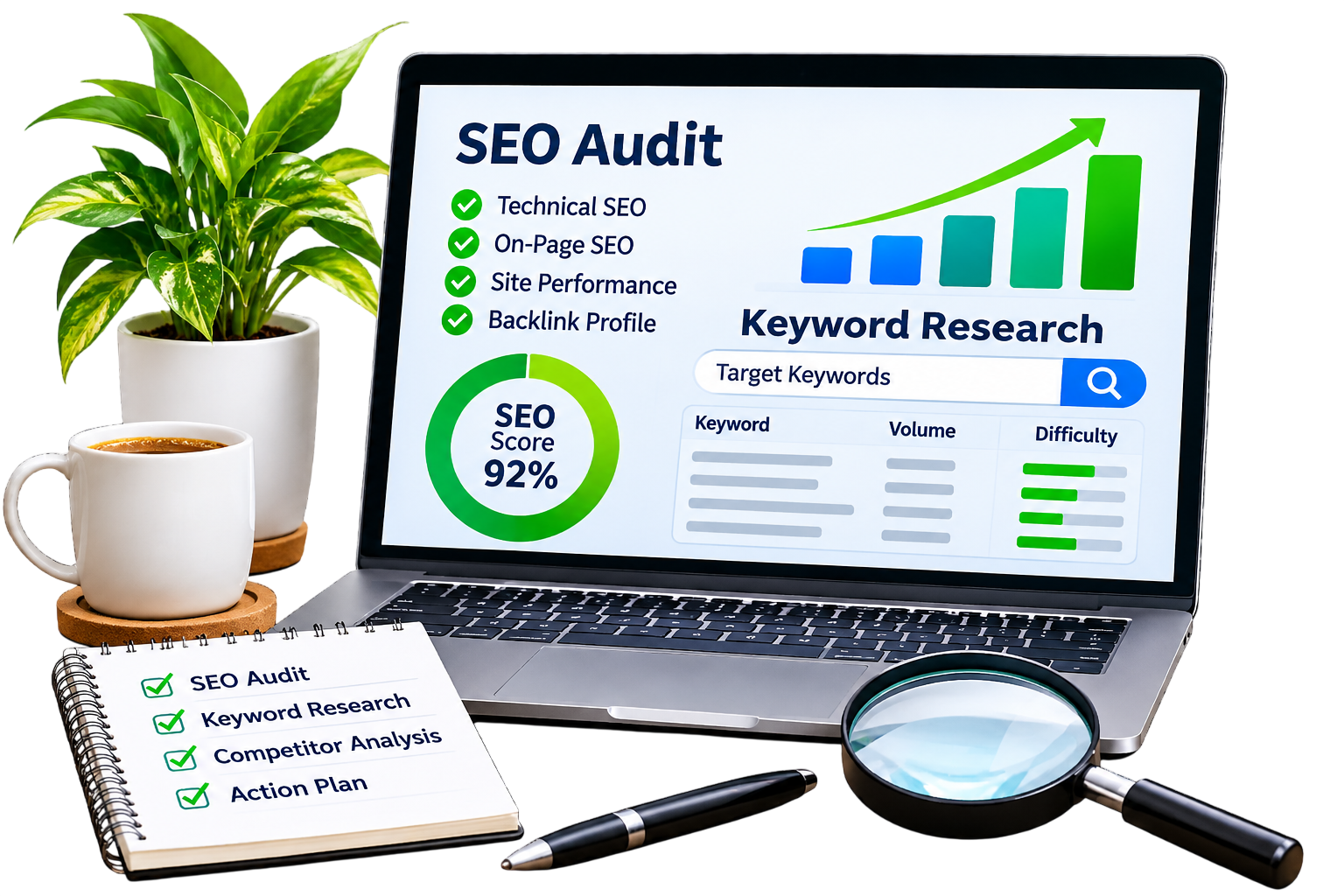
SEO Audits & Keyword Research are essential processes for understanding your website’s search engine performance and identifying opportunities to improve organic visibility.
An SEO audit evaluates your website’s technical health, content quality, on-page elements, backlink profile, indexing and overall search performance to identify issues that may affect SEO.
Keyword research identifies the search terms and queries your target audience uses when looking for products, services or information related to your business.
Combining both processes helps create a data-driven SEO strategy that targets relevant keywords, fixes website issues and attracts more qualified organic traffic.
Without a proper SEO audit and keyword strategy, your website may struggle to reach the right audience, even if it contains valuable content.
A comprehensive audit identifies optimisation gaps, while keyword research helps you understand what your potential customers are searching for.
Together, they provide a clear roadmap for improving search visibility, attracting relevant visitors and supporting business growth.
Key Benefits:
– Identify technical SEO issues affecting website performance.
– Discover relevant keywords and search opportunities.
– Understand user search intent and customer behaviour.
– Analyse competitor SEO strategies and keyword gaps.
– Improve website content and page optimisation.
– Prioritise SEO activities based on business goals.
– Build a measurable, long-term organic growth strategy.

Evaluate your website’s overall SEO health, including technical performance, content quality, website structure, indexing and backlink profile.

Identify technical issues related to website crawling, indexing, redirects, XML sitemaps, robots.txt, canonical tags, JavaScript rendering and Core Web Vitals.

Review title tags, meta descriptions, heading structure, keyword placement, internal links, image optimisation and content relevance.
Analyse your backlink profile, referring domains, anchor text distribution and link quality to identify authority-building opportunities and potential risks.
Identify relevant primary, secondary, long-tail and commercial keywords based on your products, services, target audience and business objectives.
Understand whether users are searching for information, comparing solutions, looking for specific websites or preparing to make a purchase.
Analyse competitor keyword rankings, organic visibility, content strategies and keyword gaps to discover opportunities for your website.

Group related keywords according to search intent and topic relevance, then map them to appropriate website pages to avoid unnecessary keyword overlap.
Identify missing topics, unanswered customer questions and content opportunities that can strengthen your website’s topical coverage.
Prepare actionable SEO reports with technical findings, keyword opportunities, competitor insights and prioritised recommendations.
Understand your business objectives, target audience, website structure, existing SEO performance and industry requirements.
Evaluate the website’s technical health, on-page optimisation, content quality, backlink profile and overall search performance.
Identify crawling, indexing, redirect, canonicalisation, sitemap, robots.txt, mobile usability and Core Web Vitals issues.
Discover relevant primary, secondary, long-tail and commercial keywords by analysing search demand, competition and business relevance.
Classify keywords according to informational, navigational, commercial and transactional search intent to align content with user expectations.
Analyse competing websites to identify ranking keywords, content opportunities, backlink gaps and potential areas for improvement.
Organise keywords into relevant topic clusters and map them to existing or new website pages based on search intent.
Categorise audit findings according to their impact, urgency and implementation effort to create a practical optimisation roadmap.
Prepare a detailed report containing technical findings, keyword research data, competitor insights and recommended actions.
Monitor keyword rankings, organic traffic, indexing, website health and SEO performance to refine the strategy over time.
We evaluate keyword opportunities using important search metrics and business relevance.
| SEO Audit & Keyword Research Service | What We Do | Business Benefit |
|---|---|---|
| Website SEO Audit | Analyse overall website SEO health and optimisation gaps. | Identifies improvement opportunities. |
| Technical SEO Audit | Review crawling, indexing, redirects and website performance. | Improves technical website health. |
| On-Page SEO Audit | Evaluate titles, headings, content and internal links. | Improves page relevance. |
| Backlink Audit | Review referring domains, anchor text and backlink quality. | Supports a healthier backlink profile. |
| Keyword Research | Discover relevant keywords and search opportunities. | Targets the right audience. |
| Search Intent Analysis | Understand user queries and search behaviour. | Improves content relevance. |
| Competitor Analysis | Research competitor rankings and keyword strategies. | Identifies competitive opportunities. |
| Keyword Mapping | Assign relevant keywords to website pages. | Reduces keyword cannibalisation. |
| Content Gap Analysis | Find missing topics and content opportunities. | Strengthens topical coverage. |
| SEO Reporting | Deliver audit findings and actionable recommendations. | Supports data-driven decisions. |
Businesses that want steady organic growth
MindEdge is a UK digital marketing agency. We combine SEO, paid ads, social, lead generation, creative and AI-powered websites to bring you customers.
AI Search Optimisation includes GEO, AEO, LLMO, AI-friendly content optimisation, entity building, structured data, technical accessibility and AI search visibility monitoring.
Traditional SEO focuses on improving website visibility in search engine results. AI Search Optimisation extends this approach to AI-powered search experiences, where platforms generate answers, reference sources and help users discover businesses.
Both approaches work together to strengthen your overall digital visibility.
GEO focuses on improving content and brand visibility across generative AI platforms. It involves creating useful, authoritative and relevant information that AI-powered search experiences can understand and potentially reference.
AEO focuses on structuring website content to provide clear answers to user questions. It includes FAQs, conversational queries, informative headings and concise, accurate explanations.
AI Search Optimisation can focus on platforms and experiences such as ChatGPT Search, Google AI Overviews, Google AI Mode, Perplexity and other AI-powered discovery tools.
The timeline depends on your website’s existing authority, content quality, industry competition and technical accessibility. Improvements in visibility may take time, and AI platform mentions or citations cannot be guaranteed.
Yes. Technical accessibility, helpful content, relevant internal linking, strong website structure and established SEO practices remain important foundations for AI search visibility.
Relevant structured data helps search engines understand your website content and can support eligibility for certain search features. However, there is no special schema markup that guarantees inclusion in AI-generated answers.
LLMO focuses on strengthening your brand’s information, content and digital presence so large language model-powered experiences can better understand your business and its expertise.
Your website should be accessible to relevant crawlers, properly indexed and structured for discovery. For example, websites seeking inclusion in ChatGPT search should review access for OpenAI’s OAI-SearchBot.