Question-Based Keyword Research
Identify relevant questions, conversational queries and long-tail keywords your target audience uses when searching for products, services and information.

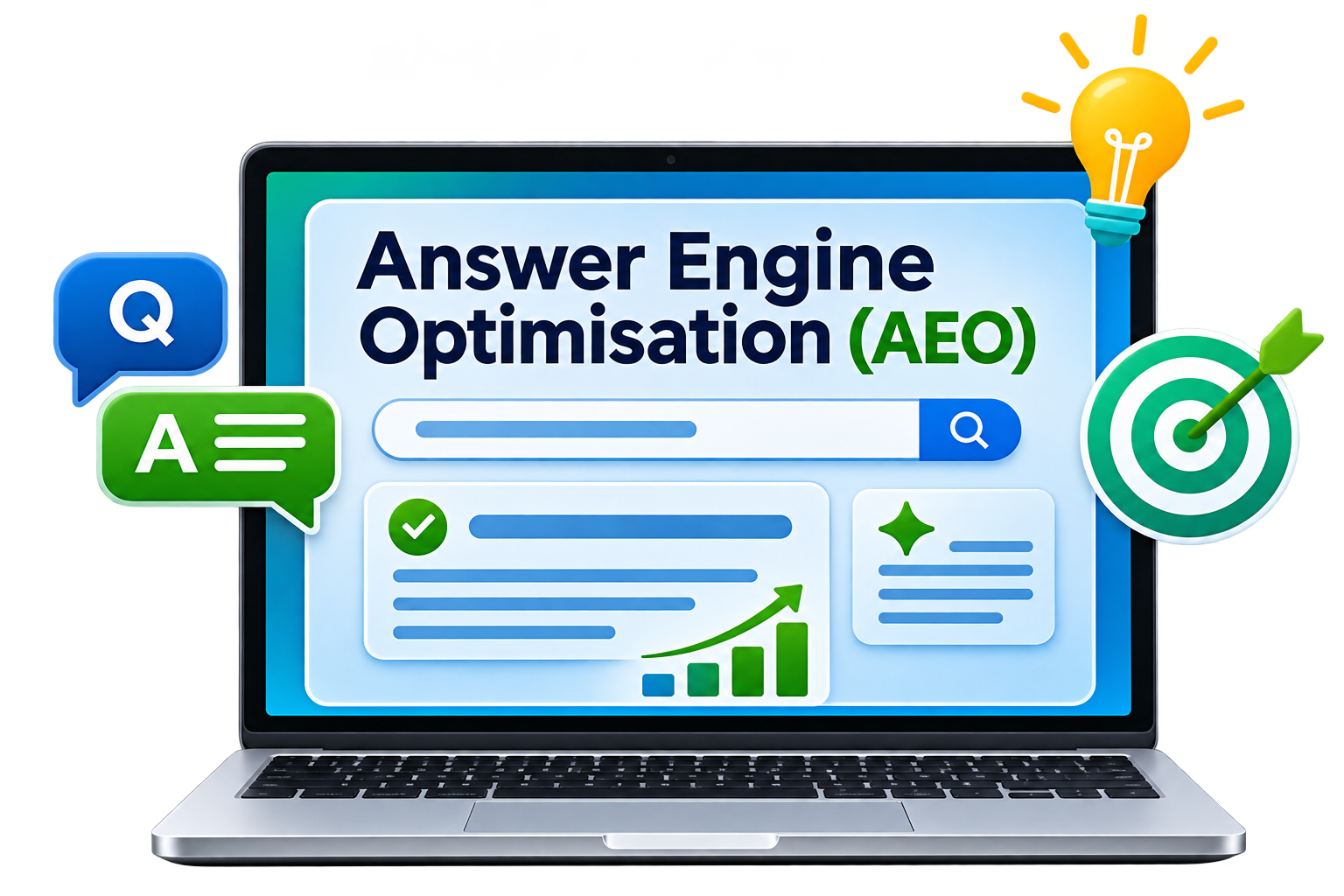
Answer Engine Optimisation (AEO) is the process of optimising website content, structure and digital information to help search engines and AI-powered answer platforms understand and present relevant answers to user queries.
Unlike traditional SEO, which primarily focuses on improving organic search rankings, AEO focuses on making your content easy to discover, interpret and use when search platforms generate direct answers.
It involves conversational keyword research, question-based content, structured information, FAQ optimisation, semantic SEO and authoritative content development.
A strategic AEO approach helps businesses improve their chances of appearing in featured snippets, People Also Ask results, voice search responses and AI-powered answer experiences.
Search behaviour is changing as users increasingly search through questions and expect quick, accurate and relevant answers.
Instead of browsing multiple websites, users often look for direct answers through search engines, voice assistants and AI-powered platforms.
Without properly structured and informative content, your website may miss opportunities to appear in these answer-focused search experiences.
AEO helps businesses organise their information around user questions and provide useful answers that search systems can understand.
Key Benefits:
– Improve opportunities to appear in featured snippets.
– Increase visibility in question-based search results.
– Optimise content for conversational search queries.
– Improve opportunities for voice search visibility.
– Strengthen brand recognition across answer engines.
– Make website information easier to understand.
– Support visibility across AI-powered answer experiences.
– Attract relevant visitors through informational searches.

Identify relevant questions, conversational queries and long-tail keywords your target audience uses when searching for products, services and information.

Understand what users want to know and classify their searches according to informational, commercial, navigational and transactional intent.

Structure relevant website content with concise explanations, descriptive headings, lists and tables to improve eligibility for featured snippets.

Develop relevant frequently asked questions and clear answers that address customer concerns, industry topics and informational search queries.
Optimise content around natural-language questions, conversational phrases and local search queries commonly used in voice-based experiences.
Create clear, direct and contextually relevant answers that address specific user questions while maintaining useful supporting information.

Implement relevant structured data to help search engines understand website content, services, products and business information.

Improve contextual relationships between topics, keywords, entities, services and business information to strengthen content understanding.
Research related questions and develop useful supporting content that addresses common follow-up queries within your industry.
Monitor featured snippet opportunities, question-based keyword rankings, search visibility and brand presence across relevant answer-focused platforms.
Evaluate your website’s content structure, technical SEO, existing search visibility and answer-focused optimisation opportunities.
Identify frequently searched questions, conversational keywords, long-tail queries and customer concerns related to your business.
Analyse user intent, competitor content and existing answer-focused search results to identify opportunities for improved visibility.
Review featured snippets, People Also Ask results, AI Overviews and other relevant search result features to understand how answers are presented.
Create informative content that directly answers user questions using clear explanations, concise definitions, practical examples and supporting details.
Organise website information using question-based headings, descriptive paragraphs, relevant lists, comparison tables and contextual internal links.
Implement appropriate Schema.org structured data, such as Article, Organization, Product, Service and other relevant types based on page content.
Review crawling, indexing, mobile usability, JavaScript rendering, page performance and content accessibility.
Strengthen content with expert insights, original information, reliable references and consistent business details.
Monitor featured snippet visibility, question-based keyword performance, AI citations, organic traffic and content opportunities to continuously improve your AEO strategy.
We monitor important performance indicators to understand how your content performs across answer-focused search experiences.
| AEO Service | What We Do | Business Benefit |
|---|---|---|
| Question-Based Keyword Research | Discover relevant user questions and conversational queries. | Targets audience search needs. |
| Search Intent Analysis | Analyse the purpose behind search queries. | Improves content relevance. |
| Featured Snippet Optimisation | Structure content for direct-answer opportunities. | Improves snippet eligibility. |
| FAQ Content Optimisation | Develop useful question-and-answer content. | Addresses customer questions. |
| Voice Search Optimisation | Optimise natural-language and conversational queries. | Supports voice-based discovery. |
| Conversational Content | Create clear, direct and informative answers. | Improves information accessibility. |
| Schema Optimisation | Implement relevant structured data. | Helps search engines interpret content. |
| Semantic SEO | Strengthen relationships between topics and entities. | Improves contextual understanding. |
| People Also Ask Optimisation | Identify and answer related search questions. | Expands question-based coverage. |
| AEO Performance Monitoring | Track answer visibility and search performance. | Measures optimisation progress. |
Businesses that want steady organic growth
MindEdge is a UK digital marketing agency. We combine SEO, paid ads, social, lead generation, creative and AI-powered websites to bring you customers.
Answer Engine Optimisation is the process of improving website content and structure to help search engines and AI-powered platforms identify and present relevant answers to user questions.
AEO helps businesses improve their opportunities to appear in featured snippets, question-based search results and AI-generated answers, increasing brand exposure and discoverability.
Traditional SEO focuses on improving organic search visibility and rankings, whereas AEO focuses on structuring information so search systems can identify and present direct answers to user queries. Both strategies work together.
AEO improves featured snippet opportunities by organising content around specific questions, providing concise answers and using relevant lists, tables and descriptive headings. Google ultimately selects featured snippets automatically.
Yes. AEO can help organise content around natural-language questions and conversational queries, making information easier to understand and potentially useful for voice-based search experiences.
AEO traditionally focuses on direct answers, featured snippets and answer-focused search experiences. GEO focuses on improving brand visibility and citations in generative AI responses. Both approaches increasingly overlap.
Structured data helps search engines understand the meaning and context of website information. However, implementing schema does not guarantee featured snippets, AI citations or special search appearances.
People Also Ask optimisation involves researching related questions displayed in search results and creating useful content that addresses those questions.
AEO performance can be measured through featured snippet appearances, question-based keyword visibility, AI citations, search impressions, organic traffic and brand mentions.
No. AEO complements traditional SEO. Strong technical foundations, relevant content, website accessibility and authority remain important for overall search visibility.