
In today’s competitive UK market, having a website is not enough.
Traffic alone doesn’t grow your business — conversions do.
To consistently generate leads, businesses need a full-funnel digital strategy that guides users from awareness to enquiry — and beyond.
Let’s break down how to turn your website into a lead-generating machine.
What Is a Full-Funnel Digital Strategy?
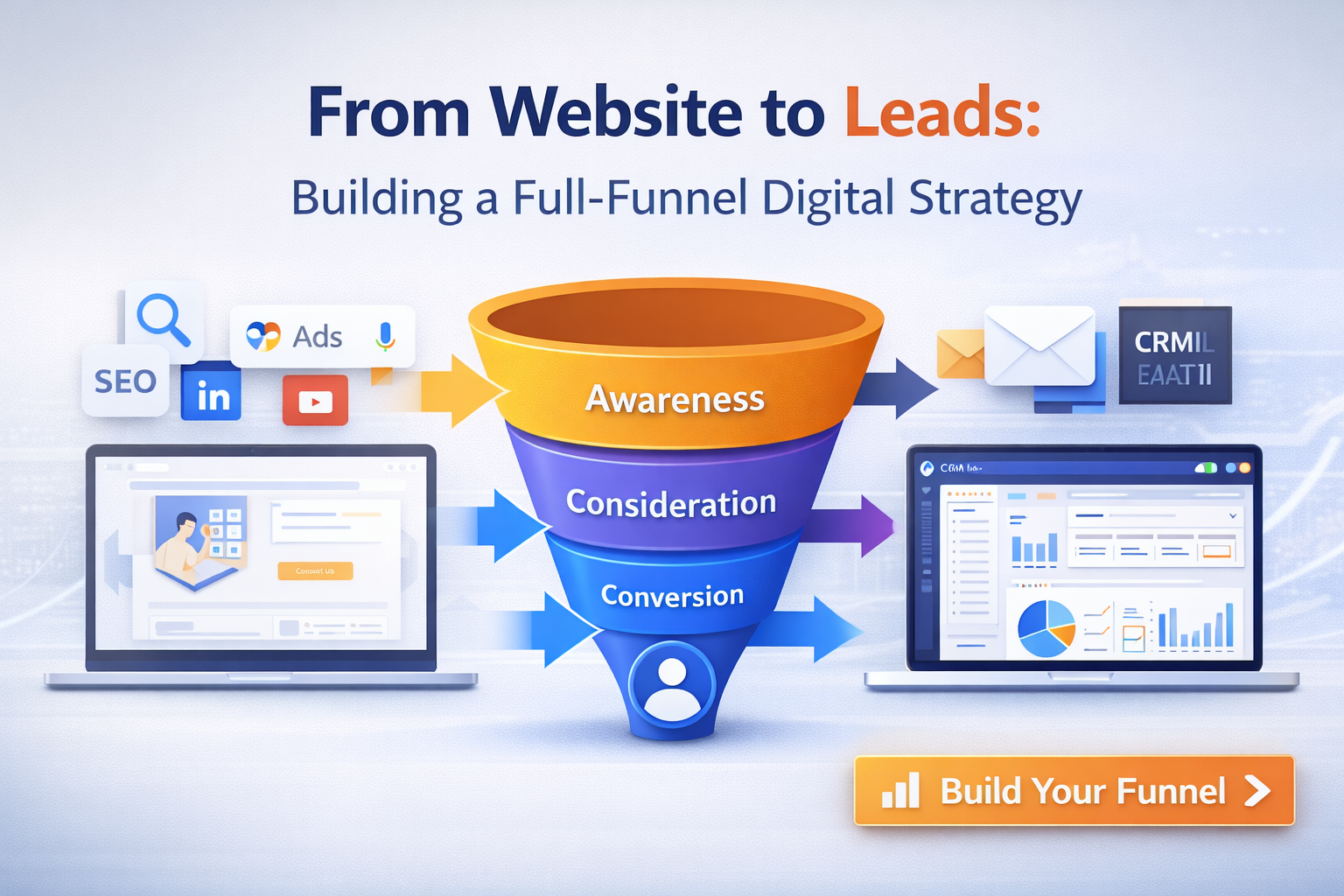
A full-funnel strategy focuses on every stage of the buyer journey:
| Funnel Stage | Goal | Strategy Type |
|---|---|---|
| Awareness | Attract new visitors | Ads, SEO, Social Media |
| Consideration | Build trust & educate | Content, Email, Retargeting |
| Conversion | Turn visitors into leads | Landing pages, CTAs, Forms |
| Retention | Nurture & upsell | Email automation, CRM |
Instead of isolated marketing efforts, everything works together.
Step 1: Build a High-Converting Website Foundation
Your website is the centre of your funnel.
Must-Haves:
✔ Clear value proposition above the fold
✔ Fast loading speed (under 3 seconds)
✔ Mobile-first design
✔ Strong call-to-action (CTA)
✔ Simple lead capture forms
✔ Trust signals (reviews, case studies, certifications)
Without conversion-focused design, traffic is wasted.
Step 2: Drive Targeted Traffic
You can’t generate leads without visitors.
Top Traffic Sources in the UK:
1️⃣ SEO (Search Engine Optimisation)
-
Rank for high-intent keywords
-
Long-term organic traffic
-
High ROI over time
2️⃣ Google Ads (Intent-Based Traffic)
-
Capture users actively searching
-
Strong for B2B & services
3️⃣ Meta Ads (Awareness & Retargeting)
-
Target interests & behaviours
-
Excellent for brand building
4️⃣ LinkedIn Ads (B2B Focused)
-
Professional audience targeting
-
High-quality lead generation
The key is matching traffic source to funnel stage.
Step 3: Capture Leads with Optimised Landing Pages
Sending paid traffic to a generic homepage is a common mistake.
Instead, create:
-
Dedicated landing pages
-
Clear benefit-driven headlines
-
Social proof
-
One primary CTA
-
Short, focused forms
Small improvements in conversion rate can dramatically increase ROI.
Step 4: Retarget & Nurture
Most users don’t convert on the first visit.
That’s why:
-
Retargeting ads are essential
-
Email automation builds trust
-
Follow-up sequences increase conversion rates
Example:
-
User visits pricing page
-
Sees retargeting ad
-
Downloads guide
-
Receives email sequence
-
Books consultation
That’s a working funnel.
Step 5: Measure & Optimise
A full-funnel strategy must be data-driven.
Track:
-
Website conversion rate
-
Cost per lead (CPL)
-
Return on ad spend (ROAS)
-
Landing page performance
-
Drop-off points in funnel
Optimisation never stops.
Example: A UK Service Business Funnel
Step 1: Google Ads → Target “Web Development Company London”
Step 2: Dedicated landing page
Step 3: Free consultation form
Step 4: Email follow-up sequence
Step 5: Retargeting ads
Result: Lower cost per lead & higher closing rate.
Why Most Businesses Fail at Lead Generation
❌ No clear CTA
❌ Weak landing pages
❌ No retargeting
❌ No CRM follow-up
❌ Traffic without strategy
Success comes from integration — not isolated tactics.
The Full-Funnel Formula
Awareness → Engagement → Trust → Conversion → Retention
When your:
-
Website is conversion-focused
-
Traffic is targeted
-
Messaging is consistent
-
Follow-up is automated
You turn visitors into predictable leads.
Final Takeaway
A website alone doesn’t generate leads.
A strategy does.
If you want sustainable growth in the UK market, build a system where:
✔ Your website converts
✔ Your ads attract qualified users
✔ Your funnel nurtures automatically
✔ Your data drives decisions
That’s how modern digital growth works.
If you’d like, I can also provide:
-
🔍 SEO Meta Title
-
📝 Meta Description
-
🏷 Optimised Tags
-
🎨 Banner Design Concept
-
📊 Funnel Diagram Visual